7 Red Flags and False Claims to Watch for When Buying Body Armor in 2026: A Buyer’s Guide for Law Enforcement, First Responders & Procurement Teams
The 2026 Buyer’s Reality Check
The 2026 body armor market is full of innovation — but also misinformation. With the transition to NIJ Standard 0101.07, the introduction of new lightweight materials, and a surge in online-only armor brands, both professionals and civilians are seeing more bold claims and half-truths than ever before.
If you’re:
Outfitting a law enforcement agency or corrections department
Managing a private security company or executive protection team
Running a tactical retail/e-commerce operation
Or buying armor personally for home defense or duty use
…you cannot afford to rely on marketing hype. You need a repeatable way to sort legitimate, tested armor from questionable, unverified gear.
This guide breaks down the 7 most important red flags and false claims buyers must watch for in 2026 — and explains when non-NIJ-Compliant or NIJ-Certified armor can still be appropriate depending on the mission profile. It also shows how IntelAlytic and The Armor List give you a fast, structured way to verify claims and de-risk purchases.
Before You Start: NIJ Compliance vs. Non-NIJ Armor (The Honest Reality)
One key truth up front:
For most U.S. law enforcement and public safety procurement, NIJ compliance is the requirement. If you’re spending agency dollars or issuing armor to sworn personnel, you should be living on the NIJ Compliant Products List (CPL).
But across other segments — private security, executive protection, certain specialized tactical units, and civilian buyers — non-NIJ-Compliant or NIJ-Certified armor can be completely reasonable, and sometimes even preferable (lighter, thinner, or tuned for specific threats).
Several highly reputable U.S. manufacturers offer a mix of NIJ-Compliant and non-NIJ products, including (not exhaustive):
These companies combine:
Long-standing ballistic history
Established material supply chains
Proven performance in realistic environments
Deep ties to the defense / LE marketplace
Transparent disclosure of which products are and are not NIJ-Compliant
A non-NIJ plate from a reputable manufacturer with real test data is very different from a non-NIJ plate from a brand-new, PO-box-only website.
The point of this article is not “NIJ or nothing.”
The point is: every claim needs to be checked — especially in 2026.
Also, consider this recent article we wrote for clarity on the difference between language used, like NIJ Certified or NIJ Compliant
1. Missing, Fake, or “Pending” NIJ Compliance
For law enforcement agencies, government procurement teams, and uniformed public safety roles, NIJ certification is typically non-negotiable. If policy says “must be NIJ-Compliant,” then the product must live on the official NIJ CPL, full stop.
Red flags to watch for:
A product is described as “NIJ-Compliant or NIJ-Certified”, but the exact model number is not found on the NIJ CPL.
The “certificate” has odd formatting, unverifiable signatures, or no precise model designation.
Marketing uses non-standard labels like “Level III+” or “Level IV+” as if they were official NIJ levels (they aren’t; they are marketing shorthand).
The company says certification is “pending,” “in process,” or “expected next quarter” — but treats it as if approval already exists.
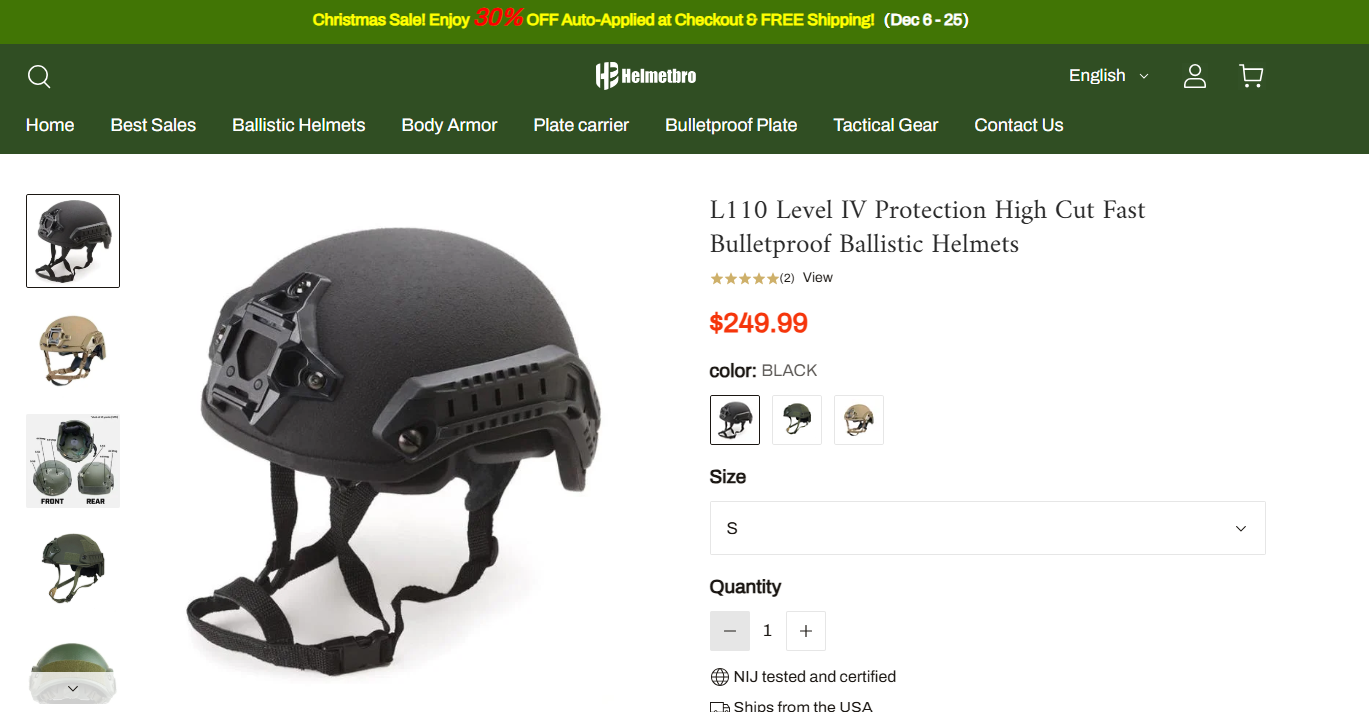
A clear example of a scam product being marketed by Helmet Bro
Important nuance:
While NIJ certification is the procurement baseline for most government use, non-NIJ armor is not automatically low quality. In some mission sets, it’s the right tool.
Legitimate non-NIJ use cases:
Private security and executive protection: lighter plates, specific cuts, or discreet soft armor not yet submitted to NIJ
Specialized tactical teams: mission-specific plates (e.g., ultra-light swimmer cuts, special threat plates)
Civilians: personal protection plates tested to specific threats without going through NIJ’s full CTP process
Military: often operates under completely different test standards and threat matrices
In these segments, your job shifts from “Is it on the CPL?” to “Show me the data, the lab, and the company behind it.”
Verification essentials:
NIJ CPL: search the exact model number
The Armor List: cross-check NIJ listing, lab, company profile, and test history in one place
2. Pricing That Is Too Good to Be True
Armor is material- and process-intensive. When the price is insanely low, corners are being cut somewhere.
Ultra-low pricing can signal:
Cheap, low-grade UHMWPE with inconsistent performance
Ceramic strike faces with poor quality control
Unverified overseas manufacturing with no audit trail
No formal quality management system (e.g., ISO 9001, BA9000)
Approximate 2026 market ranges:
Level II/IIIA soft armor vest (with 2 x carriers): $500–$1,200
Level III UHMWPE rifle plates (pair): $600–$1,500
Level IV ceramic plates (pair): $400–$700
Can prices be below this? Yes — especially on closeouts, older models, or bulk agency deals.
But if you see:
A “full Level IIIA vest” for $250… Be cautious!
“Level IV plates” for $100 each… Double-check the source, test data, and country of manufacture!
A “Level III+, ultralightweight, multi-hit plate” for under $200 with no lab report… Run for your life!
…you should treat these as formal risk indicators, not a bargain.
3. Vague or Misleading Material Descriptions
Reputable manufacturers are very clear about what’s inside the armor. Vague marketing language is a classic red flag.
Red-flag phrases:
“Kevlar-like materials” or “military-grade alternative.”
“Proprietary fibers similar to Dyneema” (with no actual spec)
“Advanced PE” or “100% PE rifle-rated” with no density, thickness, or performance details
Overuse of buzzwords: “space-age,” “nanotech,” “world’s lightest”, etc., without real test data
Strong, credible disclosures include:
Clear ceramic callouts: alumina, silicon carbide (SiC), boron carbide (B4C)
If the seller can’t answer:
“What are the main ballistic materials in this model?”
…or dodges the question, treat that as a serious red flag.
4. No Third-Party Ballistic Testing From Recognized Labs
“Internal testing only” is not good enough when lives are on the line.
NIJ-recognized U.S. labs include:
Warning signs:
No reports at all — just marketing copy and social media photos
Test report screenshots or cut off information, not showing the full report
“In-house testing” with no independent lab validation
Test photos with no velocities, no backface deformation numbers, no conditioning info
Lab reports from unknown or non-accredited facilities with no clear chain of custody
What you should ask for:
Ballistic Threat Type and Velocity for each threat
Backface signature (BFS) data
Whether the armor was tested under conditioned (heat, humidity, tumbling, drop, mechanical wear)
How many shots per panel and where they were placed
Serious manufacturers — including those selling non-NIJ plates — can and will share meaningful test data.
5. New, Unverified, or Shell Companies
Not all new companies are bad. But body armor is not a category where you want to fund someone’s first experiment.
Check The Armor List new feature showing the location of the company’s address, including satellite and street views (Below is a prime example of a company listed on NIJ but no listed website or physical address outside of their registered agent office)
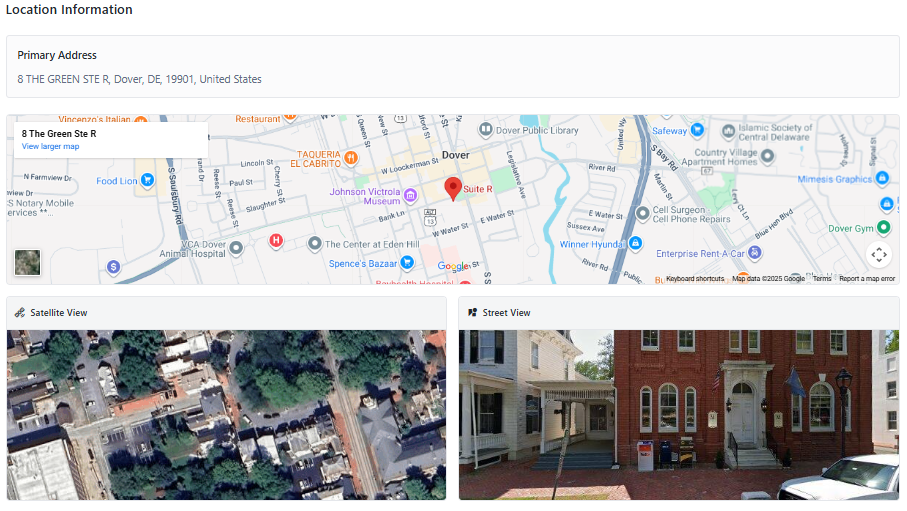
Red flags:
Only a PO box or virtual office as the “headquarters.”
Domain name registered within the last year or two, with no prior presence in the market
No visible leadership, engineering, or ballistic background
Review history limited to influencers, sponsored posts, or giveaway winners
No explanation of who actually manufactures the armor
What to look for instead:
Manufacturing lineage: Who makes the panels/plates? Where? For how long?
Industry reputation: Any known contracts, LE references, or long-term customers?
Quality systems: ISO 9001, BA9000, or documented internal QA/QC programs
Company identifiers: DUNS, CAGE, and UEI, where applicable
The Armor List pulls much of this into a single profile, including historical contracts and identifiers, so buyers don’t have to hunt across eight different sites.
6. Warranty and Return Policies That Lack Transparency
Armor is a long-term asset. Reputable manufacturers stand behind ballistic components, stitching, and carrier construction.
Healthy, normal policies often include:
5–10 year ballistic warranties (consistent with NIJ guidance on soft and hard armor)
30–60 day fit and comfort exchange windows
Clear conditions around field use, impact, and testing
Red flags:
“All sales final — no returns on armor.”
Only 1-year limited coverage on ballistic protection
Warranty voided for reasons like “Wear” or “Deployment.”
No written warranty at all — just a vague website statement
Short, restrictive, or confusing warranties often correlate with short product lifespans and minimal QA.
7. Sellers Who Dodge Questions or Avoid Transparency
The final red flag is behavioral, not technical.
Professional armor companies — especially those with a serious NIJ and LE footprint — will answer hard questions calmly and thoroughly.
Red-flag behaviors:
Evasive or defensive responses when asked about NIJ status, lab reports, or materials
Aggressive “buy now” pressure, limited-time gimmicks, or heavy emotional appeals
Refusal to provide additional documentation, even under NDA for agencies
No willingness to send sample cutaways or non-functional demo plates to qualified buyers
If a seller can’t handle basic questions like:
“Is this specific model listed on the NIJ CPL?”
“Which lab tested this, and can you show a summarized report?”
“Is this plate NIJ-Compliant or NIJ-Certified, or is it a special-threat/non-NIJ model?”
…you shouldn’t trust them with your life or your agency’s liability.
What About Reputable Companies Selling Non-NIJ Products?
This nuance matters.
As mentioned earlier, several highly respected armor manufacturers offer both NIJ-Compliant or NIJ-Certified and non-NIJ-Compliant or non-NIJ-Certified products, including:
Their non-NIJ offerings often exist for good reasons:
Extremely light plates optimized for mobility
Special-threat plates tuned for specific rifle rounds outside standard NIJ test matrices
Plates and soft armor for markets outside NIJ’s focus
Reducing Cost to consumers in civilian non-LE/FIRE/Public Safety arenas
These companies typically:
Clearly distinguish NIJ-Compliant or NIJ-Certified models from non-NIJ-Compliant models
Provide robust test data even on non-NIJ products
Maintain strong reputations with agencies, distributors, and end-users
When NIJ-Compliant or NIJ-Certified is the requirement:
Purchasing for law enforcement or corrections duty use
Using agency, government, or grant funds (i.e. BVP)
Operating under procurement rules that reference NIJ directly
When non-NIJ can be appropriate:
Civilians buying armor for personal use, with eyes wide open and data in hand
Private security and EP teams with clear internal standards
Specialized tactical or military roles operating under different threat models
The key isn’t “certified vs. non-certified” in the abstract.
The key is: Is the product’s performance honestly represented, independently tested, and appropriate for your risk profile?
The Armor List Advantage: Verify Every Detail Before You Buy
The Armor List, powered by IntelAlytic, exists for one reason: to give buyers a single, trusted place to verify armor, companies, and claims before money leaves the account.
What The Armor List brings to the table:
Real-time NIJ CPL matching for specific models
Manufacturer verification: CAGE, DUNS, UEI, contract history
Pricing benchmarks to flag suspiciously cheap offerings
At-a-glance material, weight, and thickness comparisons
Access to lab and test report data where available
Warranty transparency and support scoring
Alerts for expired, recalled, or revoked armor models
For procurement teams, integrators, and retailers, The Armor List becomes a pre-purchase due diligence checklist in digital form.
Explore the platform: The Armor List
2026 Body Armor Procurement Checklist
Use this as your quick-reference worksheet:
Compliance
☐ Model appears on the NIJ CPL (if required by policy)
☐ Certificates match model numbers and test versions
☐ Lab test reports are from recognized or credible facilities
Manufacturer Credibility
☐ Company has a verifiable history and traceable supply chain
☐ Materials are clearly disclosed and technically plausible
☐ Product performance claims are backed by data, not just photos
Mission Alignment
☐ NIJ-Compliant or NIJ-Certified model used for LE / public safety when policy requires it
☐ Non-NIJ product only used where allowed — and fully vetted for threat profile
Support
☐ Written ballistic warranty (5–10 years)
☐ Reasonable returns/exchanges for sizing and fit
☐ Company responsive to technical questions
If you can’t check these boxes with confidence, keep looking.
Conclusion: Verification Over Assumption
NIJ compliance, or often referred to as NIJ certification, remains the gold standard for government procurement and duty use, but non-NIJ armor can be entirely valid when chosen from reputable manufacturers and matched carefully to mission needs.
In a 2026 marketplace full of bold claims, your edge is simple:
Don’t assume. Verify.
That’s where IntelAlytic and The Armor List come in — giving buyers, agencies, and retailers a clear, data-driven way to separate verified protection from unsafe noise.
Want Your Brand in Front of Serious Buyers?
If you’re a reputable manufacturer or integrator and want your products positioned in front of agencies, procurement officers, and serious industry buyers, The Armor List offers sponsored, data-backed product features.
Or email support@intelalytic.com