The Definitive Guide to Responding to Government RFIs, RFQs, RFBs, and RFPs for Body Armor
How Body Armor Manufacturers, Distributors, and Suppliers Can Organize, Shred, prepare, and Submit Compliant Bids — and Perform Confidently Through Evaluation
Why Government Body Armor Bids Are Won or Lost Long Before Price
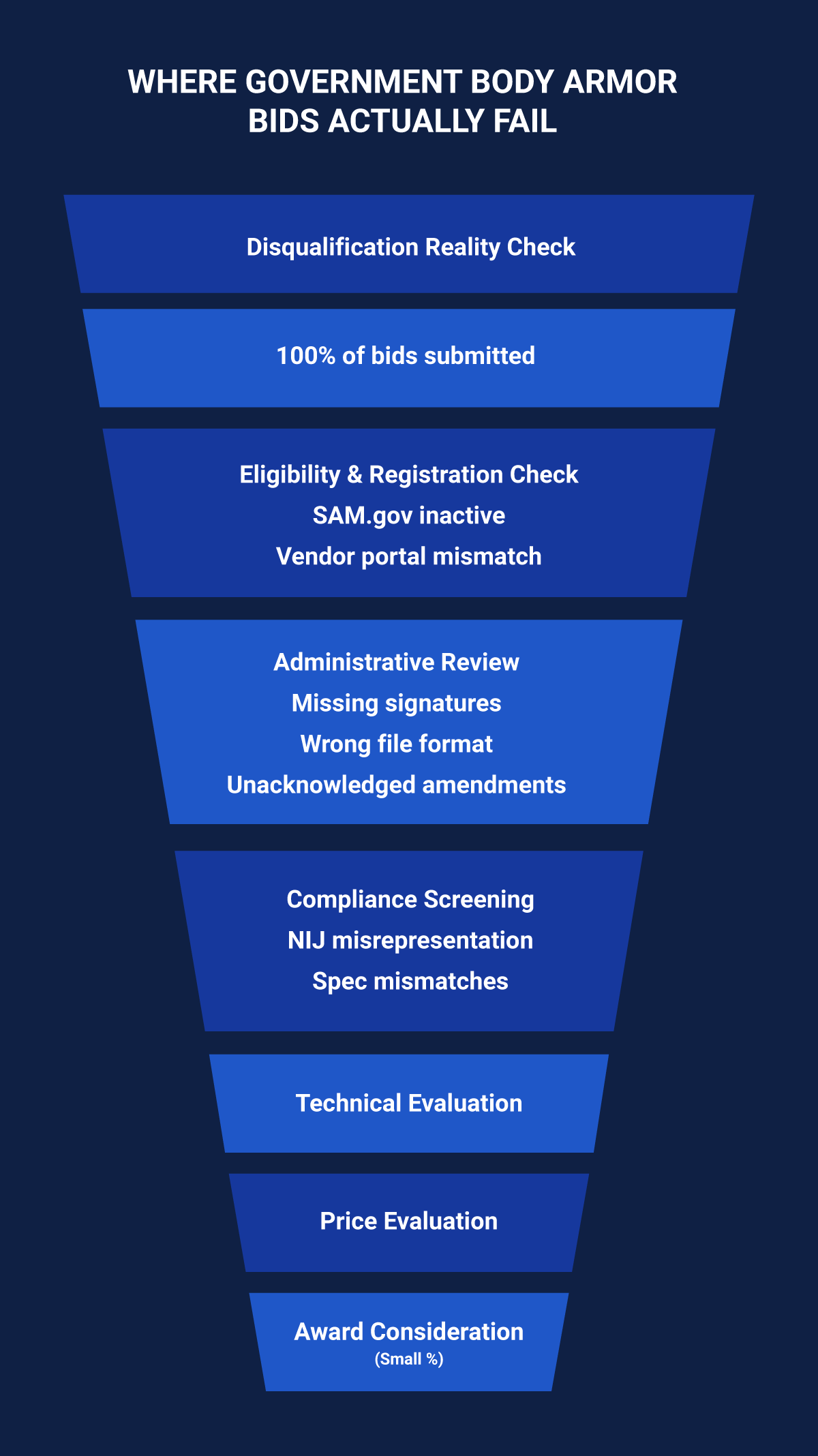
Government procurement of body armor is expanding across city, state, federal, and cooperative channels, driven by officer safety initiatives, grant funding, and modernization efforts. Yet despite strong demand, most bids never reach technical or price evaluation.
They fail earlier during eligibility checks, administrative review, or compliance screening.
In real solicitations, vendors are disqualified for reasons unrelated to ballistic performance, including:
Incorrect or expired registrations
Missing signatures or authority documentation
Improper pricing formats or altered templates
Unverified or misrepresented NIJ claims
Failure to follow submission instructions exactly
This guide exists to address that reality and is accompanied by our FREE Government Body Armor Bid Compliance Checklist, a practical tool designed to help you verify every step before submission.
What follows is a plain-English, end-to-end process for responding to government RFQs and RFPs for body armor and related ballistic products. It is built on actual procurement structures used by cities, states, cooperative purchasing programs, and federal agencies — not theory or marketing assumptions.
If followed correctly, this process helps vendors:
Avoid preventable disqualification
Demonstrate professionalism and preparedness
Reduce risk during evaluation and audit
Compete confidently at every level of government
Why Governments Use Different Names: RFIs, RFQs, RFBs, and RFPs
Government procurement is governed by process discipline, not marketing language. Each solicitation type signals where the agency is in its buying decision and how your response will be evaluated.
The names are not interchangeable — and agencies expect vendors to understand the difference.
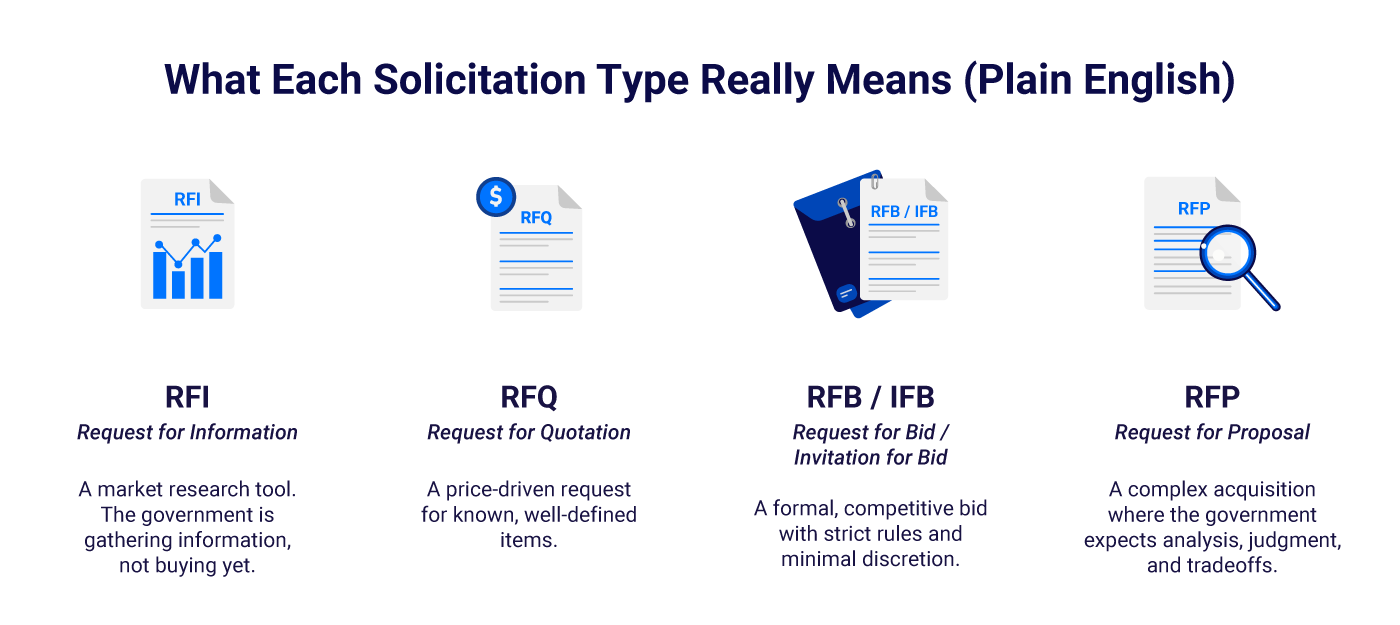
RFI — Request for Information
What it is
A market research tool. The government is gathering information, not buying yet.
What the agency wants
Market capabilities
Available products
Pricing ranges
Compliance realities
Industry feedback
What it is NOT
A bid
A contract opportunity
A guarantee of future work
How to approach it
Educate, don’t sell
Highlight capability and credibility
Avoid pricing commitments
Use it to influence future requirements
Expert signal:
Strong RFIs shape future RFQs and RFPs.
RFQ — Request for Quotation
What it is
A price-driven request for known, well-defined items.
What the agency wants
Confirmed pricing
Delivery timelines
Compliance confirmation
Common evaluation method
Lowest Price Technically Acceptable (LPTA)
How to approach it
Quote exactly what’s requested
Match specifications precisely
Avoid unnecessary narrative
Focus on compliance and price accuracy
Expert signal:
RFQs punish creativity. Precision wins.
RFB / IFB — Request for Bid / Invitation for Bid
What it is
A formal, competitive bid with strict rules and minimal discretion.
What the agency wants
Complete compliance
Proper formatting
Sealed or structured bids
Clear pricing
Common evaluation method
Lowest responsive, responsible bidder
How to approach it
Follow instructions exactly
Use only agency-provided forms
No deviations unless explicitly allowed
Administrative discipline is critical
Expert signal:
Most RFBs are lost on paperwork, not price.
RFP — Request for Proposal
What it is
A complex acquisition where the government expects analysis, judgment, and tradeoffs.
What the agency wants
Technical approach
Management capability
Past performance
Pricing rationale
Common evaluation method
Best Value Tradeoff (not always lowest price)
How to approach it
Tell a clear, compliant story
Align directly to evaluation criteria
Demonstrate understanding of agency needs
Support claims with documentation
Expert signal:
RFPs reward preparation, not speed.
Quick Intro Checklist: How to Treat Each Solicitation Type
Before you respond, ask one question: What type of solicitation is this?
RFI
Informational only
No pricing commitments
Opportunity to influence requirements
RFQ
Price and delivery focused
Specifications already defined
Compliance and accuracy matter more than narrative
RFB / IFB
Formal bid with strict rules
Use agency-provided forms only
Lowest responsive bid typically wins
RFP
Technical + management + price
Evaluation criteria drive everything
Best value may outweigh lowest price
Treating the wrong solicitation like the wrong type is one of the fastest ways to lose a bid.
Step 1: Start With Eligibility — Before You Read the Technical Specs
The first mistake many vendors make is jumping straight to armor requirements. Eligibility comes first.
Before committing bid resources, confirm you are allowed to submit.
Determine the Procurement Level
Each level of government has distinct eligibility rules:
City / Municipal
Local vendor registration
City-specific portals (e.g., PlanetBids)
Insurance requirements
Business licenses
Strict submission procedures
State
State procurement system registration
Tax compliance
Disclosure affidavits
Sometimes bid bonds
Cooperative Contracts
Pre-qualification
Standardized pricing structures
Eligibility for downstream “piggyback” users
Federal
Active SAM.gov registration
Unique Entity ID (UEI)
CAGE Code
Accurate reps & certs
If any required registration is expired, incomplete, or pending approval, stop. Submitting while ineligible is almost always grounds for rejection.
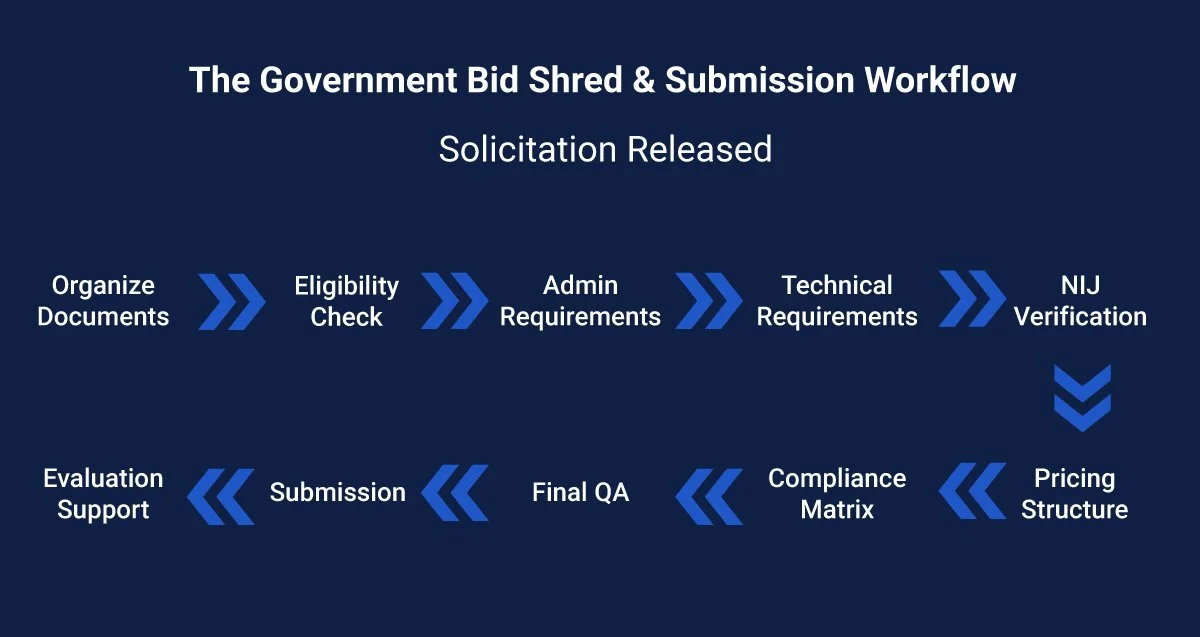
Step 2: Organize the Solicitation Before You “Shred” It
Government solicitations are rarely a single document.
Create a working folder and download:
The main RFQ or RFP
All attachments and exhibits
All amendments and addenda
Questions & Answers (if issued)
Referenced standards or external documents
Rename files clearly and track amendment dates. Amendments override original language, and failure to acknowledge them is a common disqualifier.
Step 3: What “Shredding” an RFQ or RFP Actually Means
Shredding does not mean destroying documents. It means breaking the solicitation into structured, traceable requirements.
A proper shred answers:
Are we eligible and compliant to submit?
What requirements are mandatory vs. optional?
How will the government evaluate responses?
What mistakes trigger immediate rejection?
The result is a requirement map that guides your response.
Step 4: Shred Administrative and Submission Instructions First
Administrative requirements are where most bids fail.
Extract and document:
Submission deadline and time zone
Submission method (portal, email, electronic system)
File naming conventions
Formatting rules (font type, size, spacing, margins)
Page limits (and what counts toward them)
Required forms and exhibits
Signature and authority requirements
If the solicitation states “use agency-provided forms only,” do exactly that.
Step 5: Shred Eligibility, Registration, and Legal Requirements
Identify all legal and administrative prerequisites:
Vendor portal registration under exact legal entity name
Proof of business formation and good standing
Insurance certificates meeting minimum limits
Authorized signatory documentation
Conflict-of-interest disclosures
Required certifications or affidavits
For federal bids, confirm:
SAM.gov status is active and accurate
UEI and CAGE are valid
Representations and certifications are complete
These checks often occur before technical review.
Step 6: Shred Technical Requirements — Body Armor Specific
Only now should you analyze armor requirements.
Extract clearly:
Soft armor, hard armor, shields, or combinations
Applicable ballistic standards
Threat levels and operational use cases
Sizing and fit requirements (including female-specific designs, if stated)
Weight and thickness limits
Carrier configurations and accessories
Labeling and marking requirements
Warranty terms
Each requirement must map to a product you can deliver exactly as requested.
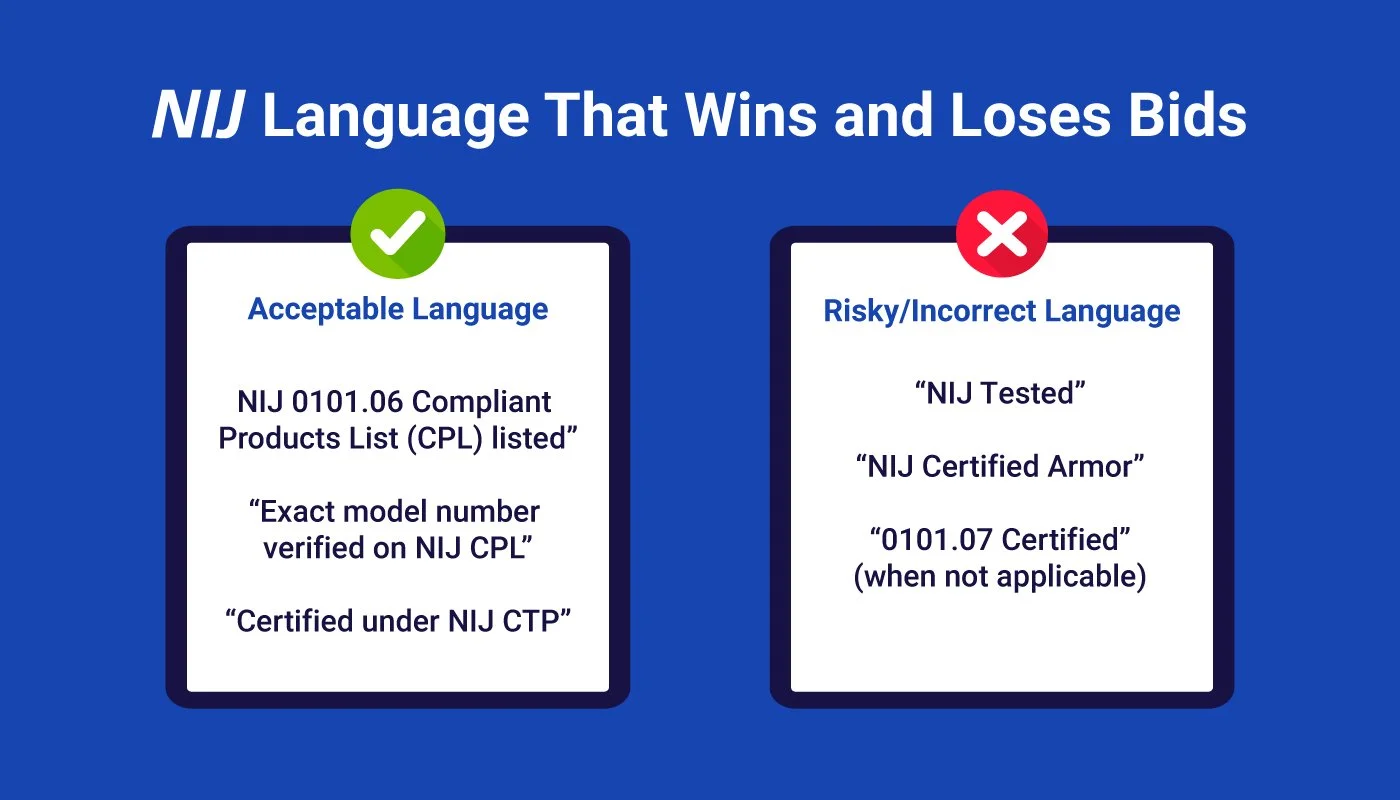
Misrepresentation — even unintentional — can result in rejection or loss of credibility.
Step 7: NIJ Compliance — Be Precise and Conservative
Accuracy matters more than marketing.
Current Status of NIJ Standards
NIJ Standard 0101.06
The current active standard. CPL listings under 0101.06 remain valid.NIJ Standard 0101.07
Published but not fully active yet. Agencies may reference or pilot it, but 0101.06 remains operationally accepted.
Do not imply that 0101.07 has replaced 0101.06 unless the solicitation explicitly states so.
What Agencies Expect
Exact CPL model number matches
Active listing status
Correct manufacturer identification
Alignment between bid product and CPL entry
“NIJ tested” ≠ “NIJ certified.”
Step 8: Quality Management and Manufacturing Credibility
Agencies increasingly evaluate how products are made and supported.
Solicitations may require or favor:
Documented quality management systems (ISO 9001 or equivalent)
Lot traceability
Change control processes
Supplier oversight
Warranty and recall procedures
Provide what exists. Do not overstate maturity.
Step 9: Pricing Strategy — Follow the Structure Exactly
Pricing errors are common and avoidable.
Confirm:
Whether pricing must use an agency-provided template
Whether pricing is fixed, ceiling, or estimated
Whether freight and accessories must be priced separately
Whether options or alternates are allowed
Never alter pricing templates unless instructed.
Step 10: Prepare Supporting Documentation — Then Organize It
Assemble documents before writing, including:
Registrations and certifications
Insurance certificates
Product data sheets
NIJ CPL documentation
Quality system descriptions
Past performance references
Name files clearly and reference them consistently.
Step 11: Ask Smart Questions — and Avoid the Wrong Ones
Productive Questions
Clarify ambiguous requirements
Identify conflicts between sections
Highlight implementation issues
Demonstrate mission understanding
Unproductive Questions
Already answered in the solicitation
Reveal lack of preparation
Attempt to negotiate requirements prematurely
Contracting officers notice the difference.
Step 12: Final Review — Double and Triple Check
Before submission:
Confirm every requirement is addressed
Verify registrations are active
Confirm signatures and forms
Acknowledge amendments
Validate file names and formats
Submit early
Step 13: Be Ready for Evaluation and Post-Submission Activity
After submission:
Monitor for clarifications
Be ready to supply documentation quickly
Expect independent verification
Silence does not equal rejection
Government Contracting Is a Process, Not a Guess
Winning government body armor contracts is not about aggressive marketing. It is about discipline, accuracy, and preparation.
Companies that succeed consistently:
Organize before writing
Shred solicitations methodically
Verify claims conservatively
Respect administrative rules
Prepare for evaluation, not just submission
Ready to Strengthen Your Next Bid?
Winning a government body armor contract starts long before the bid is submitted. By following a structured, compliant process, vendors can reduce risk, stand out during evaluation, and strengthen their reputation across procurement channels.
Download the free Government Body Armor Bid Compliance Checklist to ensure your next submission meets every requirement—across city, state, cooperative, and federal levels.
Need Expert Support?
IntelAlytic works with armor manufacturers, distributors, and procurement teams to navigate NIJ standards, contract requirements, and bid readiness.
Contact us: support@intelalytic.com
Learn more: intelalytic.com/solutions