IEEPA Tariff Ruling: Implications for Body Armor and Ballistic Supply Chains
On February 20, 2026, the U.S. Supreme Court held in Learning Resources, Inc. v. Trump that the International Emergency Economic Powers Act does not authorize the President to impose tariffs under the circumstances asserted in that action.
That decision narrows one statutory pathway for tariff action. It does not eliminate tariff exposure. It does not suspend other trade authorities. And it does not remove the operational realities facing manufacturers, distributors, integrators, and procurement officials in the body armor and ballistic protection market.
Tariffs do not apply to “armor” in the abstract. They apply to specific inputs under specific Harmonized Tariff Schedule classifications, tied to country-of-origin determinations and entry documentation. When those classifications or rates shift, the effects show up immediately in landed cost, sourcing decisions, bid pricing, lead times, and substitution pressure inside the supply chain.
This article focuses on operational implications for the ballistic protection market, not policy advocacy. It is a structural review of how the ruling interacts with ballistic-resistant soft armor, hard armor plates, ballistic helmets, ballistic shields, carriers, and related textile assemblies, and how trade shifts intersect with engineering control and compliance stability.
What the Ruling Changes, and What It Does Not
The Court’s holding is specific: IEEPA does not authorize imposing tariffs.
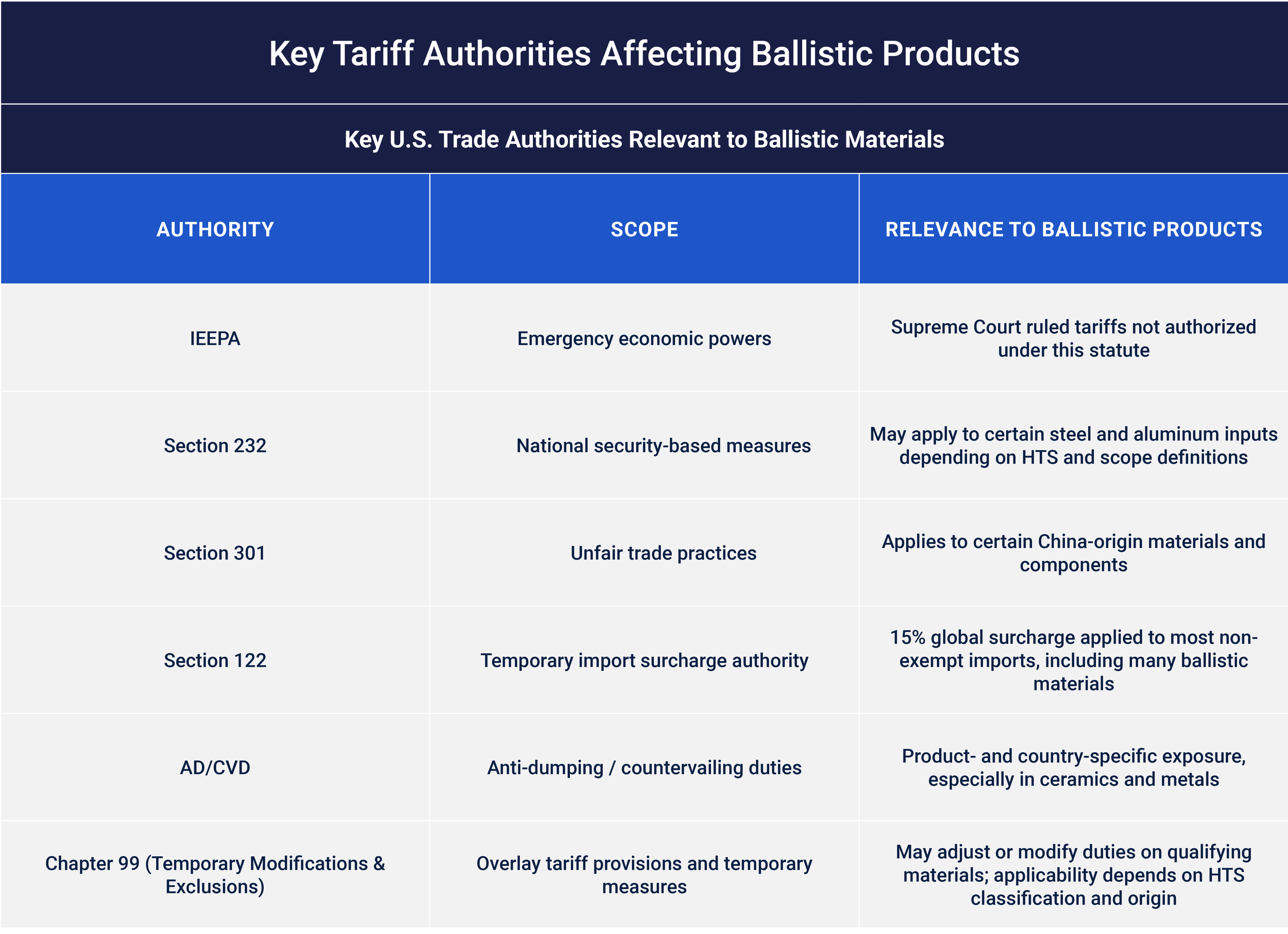
That removes one emergency-based mechanism from the executive trade toolbox. It does not invalidate other statutory authorities. Section 232 measures tied to national security determinations remain available. Section 301 measures addressing unfair trade practices remain available. Anti-dumping and countervailing duty investigations remain active tools. Temporary import surcharges under Section 122 remain lawful under defined conditions.
Section 122 authorizes temporary, across-the-board import surcharges tied to balance-of-payments concerns for a maximum period of 150 days. The statute does not provide a mechanism to extend or restart that clock once it expires. As a result, any continuation of tariff coverage beyond that period would require a transition to a different statutory authority, such as Section 232 or Section 301.
Entry Strategy During the Implementation Window
Following the Supreme Court’s decision, implementation mechanics flow through the U.S. Court of International Trade and U.S. Customs and Border Protection (CBP). The court is expected to issue formal orders that CBP will execute, including instructions on how the invalidated IEEPA tariffs are to be treated. Until such orders are issued and corresponding CBP guidance is released, importers are generally required to continue entering goods under existing tariff instructions.
During periods of implementation uncertainty, importers may evaluate operational options such as:
Deferring entry for consumption where permissible
Entering goods into a bonded warehouse status pending further guidance
Entering goods under existing tariff instructions and pursuing refund procedures if applicable
These decisions should be coordinated closely with licensed customs brokers and trade counsel, as duty exposure and timing implications can vary by shipment and entry type.
The immediate use of Section 122 authority following the ruling demonstrated how quickly tariff mechanisms can shift. For the ballistic protection sector, the lesson is straightforward: the statutory hook may change, but exposure can persist.
Planning should assume continued tariff layering and mechanism shifts rather than immediate relief.
Section 122 and Immediate Cost Layering
The announced 15% global surcharge under Section 122, effective in late February 2026, applies broadly to non-exempt imports. Section 122 permits such across-the-board measures for a maximum of 150 days, after which continuation would require transition to another statutory authority.
While certain categories described as “critical minerals” may be excluded, many ballistic fibers, ceramics, composite intermediates, specialty textiles, and related inputs used in body armor construction may not fall under broad carve-outs.
For manufacturers that diversified sourcing away from higher-exposure regions in recent years, the result is layering rather than relief.
In practical terms:
Section 301 duties may still apply to certain China-origin materials.
Section 232 measures may still apply to specific metals or derivatives.
The 15% Section 122 surcharge may apply to non-exempt imports from multiple regions.
For some manufacturers, depending on sourcing mix and classification exposure, this can translate into a net single-digit to double-digit percentage increase in landed cost in certain product lines, even after prior diversification strategies.
This is not abstract variability. It is an immediate cost event affecting production schedules and bid margins.
The Real Economic Pressure Inside Armor Programs
Over recent trade cycles, additional duties in the 10–25% range on certain inputs have translated into double-digit percentage price adjustments across portions of the ballistic market.
In a fixed-bid law enforcement or defense contract environment, a 10% increase in landed cost for a primary material does not translate to a 10% retail adjustment. It compresses margin immediately.
For larger vertically integrated firms, inventory strategy and production scale may soften the impact. For smaller and mid-sized manufacturers, sustained duty layering can determine whether a contract remains viable.
In 2025, many ballistic manufacturers absorbed millions in additional duty exposure across multi-quarter production runs tied to specific HTS classifications and origins. The Supreme Court ruling may trigger refund claims for duties previously collected under IEEPA authority. However, refund processes are entry-specific and procedural. Recovery, if available, will depend on administrative guidance and litigation outcomes.
Many importers are filing protective protests at the Court of International Trade to preserve refund rights pending formal orders and CBP guidance.
Meanwhile, agencies often delay purchasing decisions in periods of tariff uncertainty. Q1 and Q2 bid cycles can stall as procurement officials wait to see whether cost relief materializes. That delay itself becomes a material revenue consideration.
Tariff volatility in this sector does not simply change accounting entries. It disrupts bid timing, contract negotiations, and capital planning.
Why Body Armor Is Structurally Sensitive to Tariff Shifts
Body armor systems are layered constructions built from globally sourced materials.
A soft armor panel may contain high-performance fibers, unidirectional laminates, stitching thread, encapsulation films, adhesives, and a textile carrier. A hard armor plate introduces ceramic strike faces, composite backers, bonding systems, coatings, and hardware. Ballistic helmets add molded composite shells, foam systems, retention hardware, and protective coatings. Ballistic shields may incorporate composite panels, ceramics, structural frames, glazing inserts, and mounting components.
Each of these inputs may:
Enter under different HTS classifications
Originate from different countries
Carry different duty exposure
Be tied to a defined evaluated construction
In this market, construction stability and compliance stability are inseparable.
A change in fiber type, areal density, resin chemistry, ceramic supplier, adhesive film, or assembly location can alter weight, flexibility, backface deformation response, multi-hit behavior, durability, or environmental resistance.
Tariff pressure increases the incentive to change inputs. In ballistic systems, input changes are engineering events, not purchasing details. Tariff pressure increases the incentive to change inputs. In ballistic systems, input changes are engineering events, not purchasing details. Even minor changes in a design package (e.g., fiber denier shift, resin chemistry alteration, adhesive layer type) can trigger NIJ change-control review and may have Follow-up Inspection and Testing (FIT) implications or other compliance actions, depending on scope and material impact.
The Standards Landscape Across Ballistic Systems
Ballistic-resistant products operate under multiple performance frameworks.
Soft Armor Panels and Hard Armor Plates
For U.S. law enforcement procurement, NIJ performance levels remain the primary reference point.
The NIJ 0101.07 standard has been released and is in effect. However, the Compliant Products List for models certified under 0101.07 is not yet populated. Industry communications indicate that the first CTP-approved compliant models are expected to begin appearing on the updated CPL during 2026. NIJ has indicated that the 0101.06 CPL will remain active through at least the end of calendar year 2027 to support transition continuity.
This creates a dual-framework period in which legacy 0101.06 models remain operationally relevant while 0101.07 models enter the market.
NIJ listings are configuration-specific and tied to the evaluated construction. When materials shift inside a listed model, the construction must remain consistent with the evaluated configuration.
Ballistic Helmets
Ballistic helmets may be evaluated under NIJ programs where applicable, ASTM performance standards, agency-defined protocols, and, in some cases, military specifications, depending on the intended application.
These frameworks define fragmentation resistance, blunt impact performance, structural integrity, and retention requirements. Changes to composite layup, resin systems, shell geometry, or hardware driven by cost pressure can produce measurable differences under these test environments.
Ballistic Shields
Ballistic shields may be evaluated under NIJ shield standards, ASTM ballistic resistance standards applicable to shield construction, or agency-defined threat criteria.
Shield performance depends on geometry, ceramic strike faces, composite backing layers, glazing inserts, structural reinforcement, and mounting systems. A sourcing shift affecting any of these components must be evaluated against the applicable performance framework.
Textile Carriers and Accessories
Carriers and textile assemblies influence:
Coverage alignment
Plate positioning
Retention stability
Durability
Weight distribution
Operational usability
Even when not independently certified, these components contribute to system integrity and must remain controlled.
Across all categories, the same vulnerability exists: construction drift under cost pressure.
Engineering Change Control: Where Tariffs Become Compliance Risk
In NIJ-compliant body armor systems, configuration control is structural.
A listed model is evaluated as a defined construction that includes fiber types, layer counts, areal densities, adhesive films, encapsulation methods, and material sequencing.
Swapping a single adhesive film layer inside a multi-layer soft and hard armor package may appear minor from a purchasing perspective. Under NIJ compliance rules, it is not minor. That change can alter bonding integrity, flexibility, backface deformation response, or environmental durability. Depending on the scope of the change, it may trigger formal notification, Follow-up Inspection and Testing (FIT) implications, or revalidation under the NIJ compliance program.
Hybrid constructions are particularly sensitive. When woven aramid, unidirectional UHMWPE laminates, films, and encapsulation layers are combined in defined sequences, each layer contributes to the overall behavior.
A cost-driven substitution that bypasses formal engineering review can move the product outside its evaluated configuration.
Tariff volatility becomes a compliance risk when engineering change control is weak.
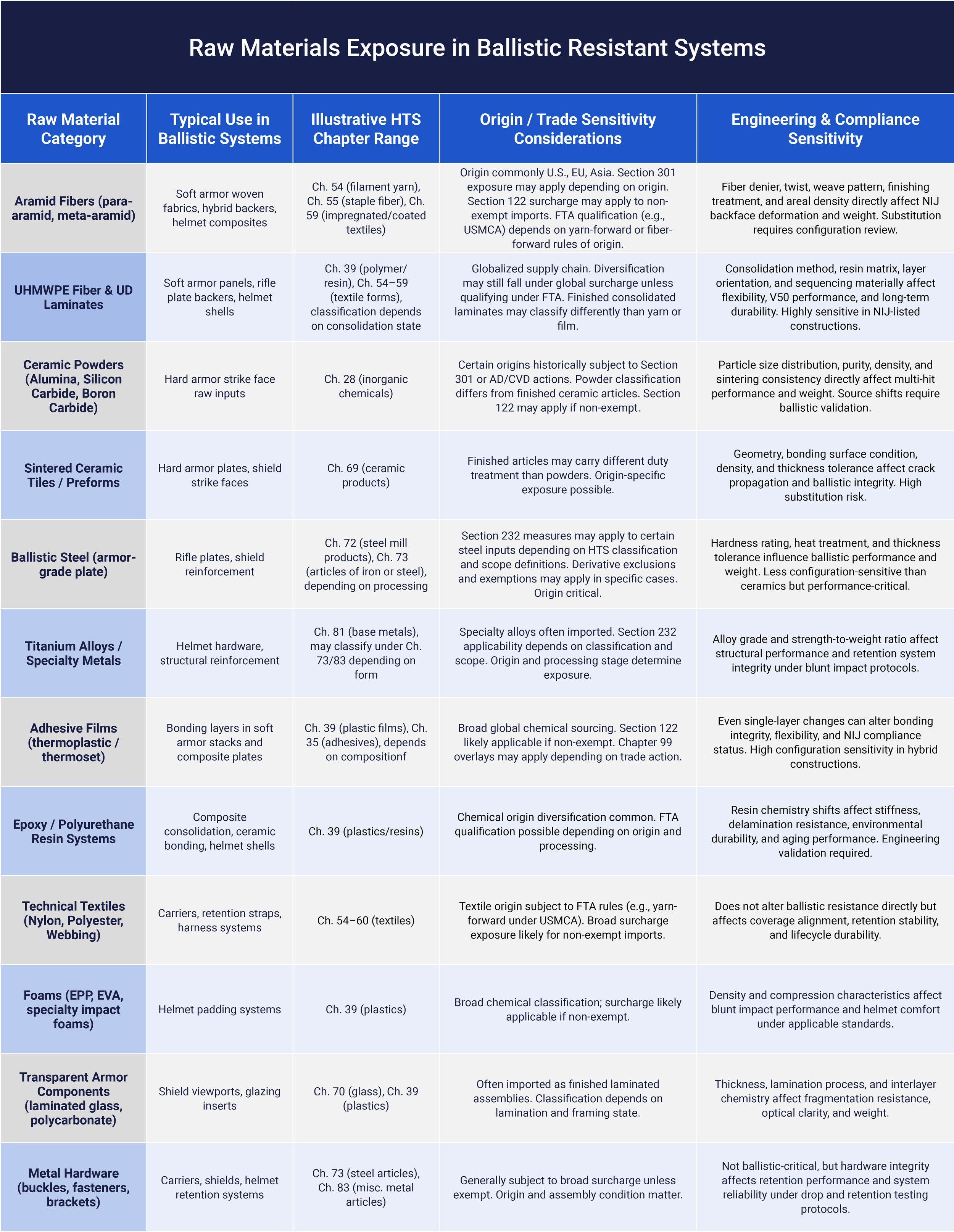
TABLE 1 — Raw Materials Exposure in Ballistic Resistant Systems
Important Notice:
HTS chapter ranges and examples are illustrative only (4/6-digit level). Actual 10-digit classification depends on exact composition, processing, import condition, country of origin, and any Chapter 99 modifications/exclusions. Duty rates and applicability vary. Always consult a licensed customs broker or request a CBP binding ruling for definitive classification and compliance. For the current HTS search, visit the USITC HTS Online Reference Tool. For NIJ-compliant model listings, see the NIJ Compliant Products List.
Finished Goods: Where Exposure Becomes Visible
When duties affect finished ballistic products, the impact becomes visible to agencies and distributors.
You see it in:
Contract line item price adjustments
Model availability shifts
Backorder patterns
Substitution proposals framed as “equivalent.”
Inventory segmentation by entry timing
Finished goods carry the largest documentation footprint. They are what agencies purchase, inventory, and deploy. If upstream materials change, that change must be traceable through the bill of materials and supplier controls.
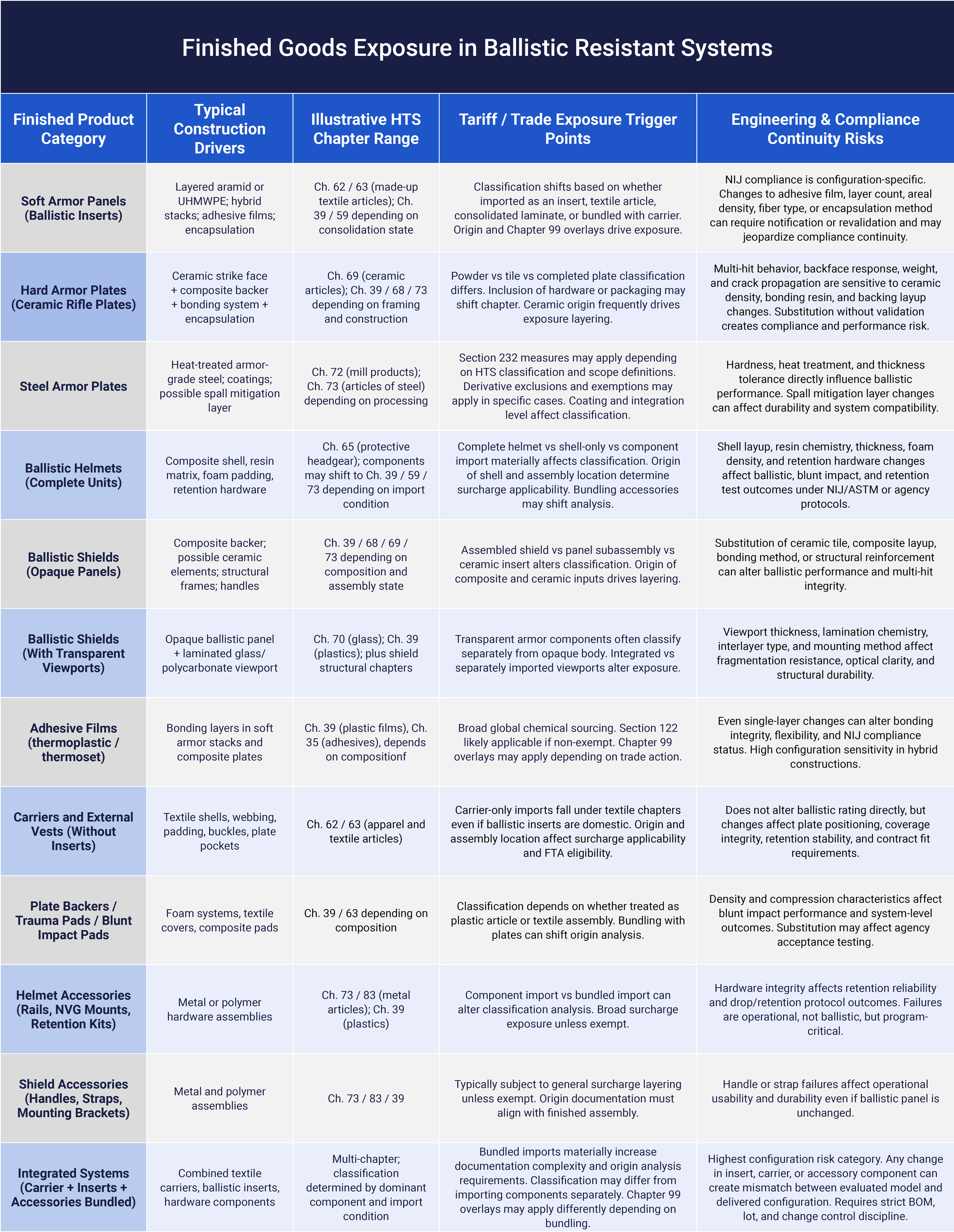
TABLE 2 — Finished Goods Exposure in Ballistic Resistant Systems
Important Notice:
HTS chapter ranges and examples are illustrative only (4/6-digit level). Actual 10-digit classification depends on exact composition, processing, import condition, country of origin, and any Chapter 99 modifications/exclusions. Duty rates and applicability vary. Always consult a licensed customs broker or request a CBP binding ruling for definitive classification and compliance. For the current HTS search, visit the USITC HTS Online Reference Tool. For NIJ-compliant model listings, see the NIJ Compliant Products List.
Reshoring and Competitive Realignment
Since the initial wave of tariff actions in 2018, many body armor manufacturers have adjusted sourcing strategies.
Some have increased domestic fiber production. Others have strengthened North American assembly capacity or diversified toward allied suppliers in Europe and Asia.
Tariff volatility accelerates these shifts.
However, reshoring is not frictionless. Domestic production of high-performance fibers, ceramic processing, composite molding, and technical textile assembly requires skilled labor, capital investment, and stable demand signals. Rapid shifts in tariff authority complicate long-term planning. Short statutory windows, such as Section 122’s 150-day limit, can further compress planning cycles for manufacturers evaluating domestic capacity expansion.
The current environment creates simultaneous pressure:
Encourage domestic and allied sourcing.
Absorb short-term cost layering.
Maintain competitive pricing in a price-sensitive public safety market.
For many ballistic manufacturers, the Section 122 surcharge functions as a fresh 10–15% layer applied across non-exempt imports, including numerous fiber intermediates, ceramic inputs, textiles, and finished subassemblies. While some materials may qualify under narrow exclusions, many ballistic-critical materials do not receive broad carve-outs. In practical terms, this can translate into immediate landed-cost increases across diversified sourcing strategies, even where prior IEEPA exposure has been removed.
For larger firms with vertical integration, volatility may be manageable. For smaller and mid-sized manufacturers, sustained duty layering can strain competitiveness.
The ruling does not remove that pressure. It reshapes it.
The Anchor Principle
Body armor programs remain defensible when the fundamentals are controlled:
What the product is made of.
Where inputs originate.
How those inputs are classified.
What changes are permitted.
What records support performance continuity.
The IEEPA ruling narrows one tariff authority. The broader lesson for the ballistic protection industry is operational.
When tariffs move, substitution pressure rises.
The organizations that remain stable are the ones whose construction control, engineering review, and documentation discipline remain intact long after the trade headlines change.
In ballistic systems, discipline inside the bill of materials matters as much as the material inside the panels.
"As this story develops, tariff implementation, refund mechanics, and potential shifts to other authorities (e.g., expanded Section 232 or 301 actions) will continue to unfold. Monitor U.S. Customs and Border Protection guidance for entry instructions and the U.S. Court of International Trade for refund developments. In ballistic systems, operational discipline — through controlled BOMs, verified HTS classifications, and formal change reviews — remains the best defense against volatility."
For Ongoing Developments:
U.S. Customs and Border Protection (CBP) Trade Updates: https://www.cbp.gov/trade/basic-import-export — For real-time guidance on entry strategies, refunds, and Section 122 implementation (e.g., exemptions and effective dates starting February 24, 2026).
U.S. International Trade Commission (USITC) HTS Online Tool: https://hts.usitc.gov/ — Search current HTS classifications, Chapter 99 modifications, and duty rates for ballistic materials as tariff actions evolve.
These links provide direct, ongoing value: CBP for procedural updates (refunds, surcharges), USITC for HTS tracking. Avoid opinion-heavy sites to maintain neutrality.