What NIJ, CJTTEC, CTP, and the CPL Actually Do—and Why the Details Matter
Confusion around body armor compliance does not come from bad actors alone. It comes from a system that is frequently discussed in shorthand, oversimplified in marketing, and poorly explained to the people who rely on it most.
Terms like NIJ certified, NIJ compliant, approved, listed, FIT, and certification ready are often used interchangeably. They are not interchangeable — and misunderstanding the differences can lead to real risk in procurement, lifecycle management, and officer safety.
This explainer is intended to clarify how the NIJ body armor compliance system actually works today, who is responsible for what, and why those distinctions matter — especially as the industry transitions from NIJ Standard 0101.06 to 0101.07.
NIJ: The Standards Authority
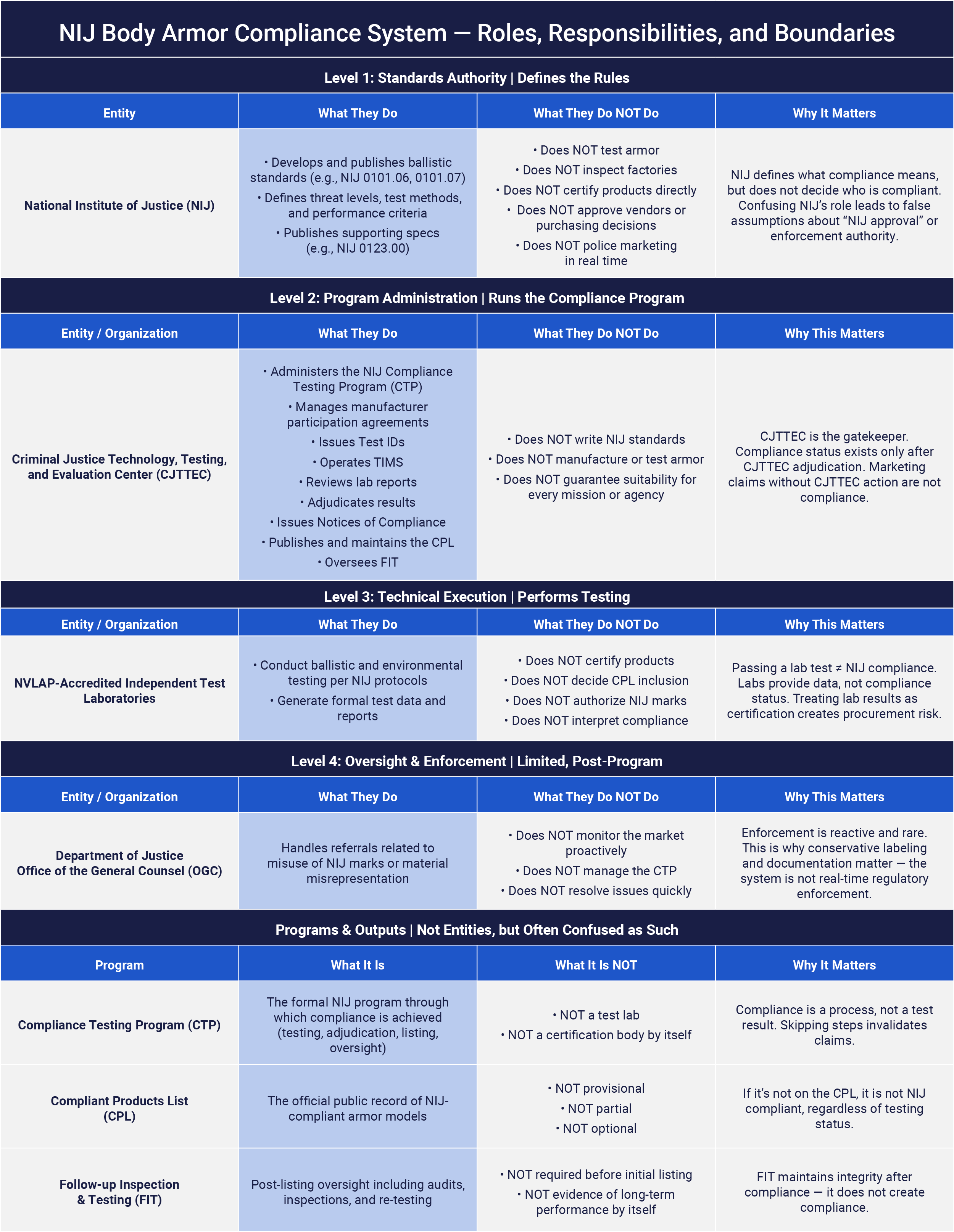
The National Institute of Justice (NIJ) is the standards-setting body for ballistic-resistant body armor used by law enforcement and corrections in the United States.
NIJ’s role is to:
Develop and publish ballistic performance standards (such as NIJ 0101.06 and 0101.07)
Define threat levels, test conditions, and performance requirements
Publish supporting specifications, including threat definitions like NIJ 0123.00
What NIJ does not do is just as important:
NIJ does not test armor
NIJ does not inspect factories
NIJ does not audit manufacturers
NIJ does not police marketing claims in real time
NIJ does not decide what agencies buy
NIJ defines what compliance means on paper. It does not manage day-to-day testing or oversight.
The Compliance Testing Program (CTP): Where Compliance Happens
Compliance with NIJ body armor standards occurs through the NIJ Compliance Testing Program (CTP).
The Compliance Testing Program (CTP) is administered by the Criminal Justice Technology, Testing, and Evaluation Center (CJTTEC), which replaced the former National Law Enforcement and Corrections Technology Center (NLECTC) structure and manages day-to-day program operations.
CJTTEC is responsible for:
Managing manufacturer participation agreements
Operating the Test and Information Management System (TIMS)
Issuing Test IDs
Reviewing laboratory test reports
Adjudicating results
Issuing Notices of Compliance
Publishing and maintaining the Compliant Products List (CPL)
Overseeing Follow-up Inspection and Testing (FIT)
In practical terms, CJTTEC is the gatekeeper. Whether a body armor model is formally recognized as compliant under an NIJ standard is determined through CJTTEC — not by the manufacturer and not by the test lab.
Independent Test Laboratories: Testing, Not Certifying
All ballistic testing under the CTP is performed by independent, NVLAP-accredited laboratories.
These laboratories conduct testing strictly according to NIJ protocols, including:
Ballistic resistance testing (V₀ / V₅₀ as required)
Backface deformation limits
Environmental conditioning
Obliquity shots
Workmanship and construction checks
Label durability and permanency
Laboratories:
Generate test data and formal reports
Do not certify products
Do not decide CPL inclusion
Do not authorize use of the NIJ mark
Their role is technical execution, not compliance determination.
The Compliant Products List (CPL): The Verifiable Outcome
The Compliant Products List (CPL) is the only public, authoritative record of which armor models have successfully completed the NIJ Compliance Testing Program for a given standard.
To appear on the CPL, a model must:
Be submitted under a valid CTP participant agreement
Receive a Test ID
Pass full laboratory testing
Complete CJTTEC adjudication
Receive a formal Notice of Compliance
Only after CPL listing may a product be represented as NIJ compliant and use the NIJ mark in accordance with program rules.
There is:
No partial CPL status
No provisional listing
No official recognition without CPL inclusion
If it is not on the CPL, it is not NIJ compliant — regardless of testing status or marketing language.
FIT: Ongoing Oversight After Listing
Once a model appears on the CPL, it becomes subject to Follow-up Inspection and Testing (FIT).
FIT includes:
Random inspections
Surprise audits at declared manufacturing locations
Sample pulls
Re-testing
Documentation reviews
FIT is post-listing oversight, not a prerequisite for initial compliance.
This distinction matters because phrases like “scheduled for FIT” or “FIT pending” are often misunderstood. Eligibility for FIT means a product has completed initial compliance. It does not mean the product has already undergone long-term oversight.
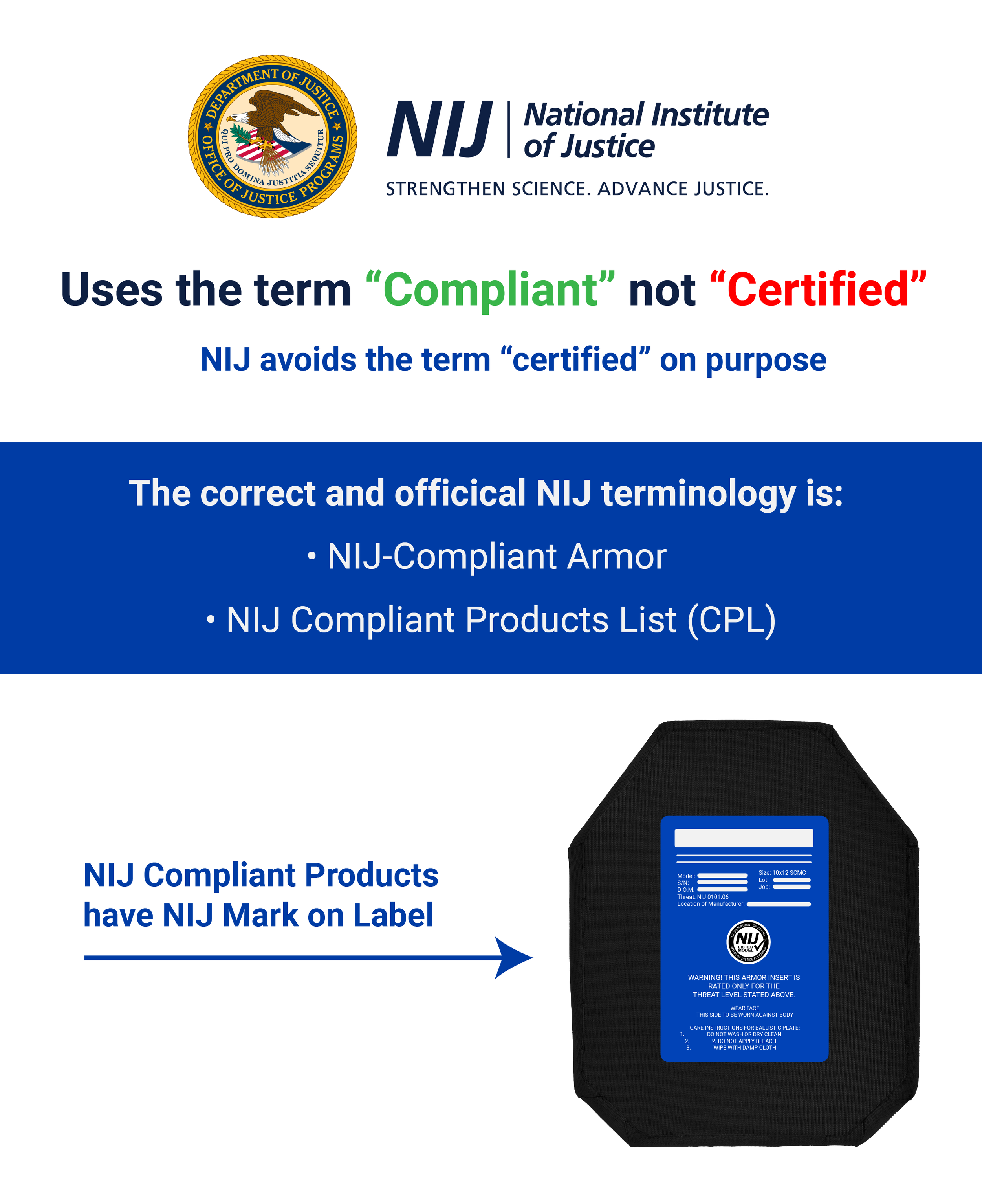
“Certified” vs. “Compliant” | Why the Language Matters
IntelAlytic NIJ Certified vs. Compliant
NIJ deliberately uses the term “compliant” rather than “certified.” This is not semantics—it is a legal and programmatic distinction.
NIJ compliance means:
The product meets the written requirements of the standard
Testing and adjudication were completed under the CTP
The product appears on the CPL
NIJ does not certify:
Mission-specific suitability
Performance in every operational environment
Fit for a particular agency’s use case
In practice, CPL listing functions as the industry’s verification mechanism — but the language remains precise by design.
Where Enforcement Ends and Why That Matters
The NIJ compliance program is voluntary and administrative.
Enforcement beyond program rules — such as misuse of the NIJ mark or material misrepresentation — may be referred to the Department of Justice Office of the General Counsel (OGC).
Historically:
OGC referrals are rare
Enforcement is reactive, not proactive
Resolution timelines can be long
This structure is not a failure of intent. It reflects the reality that the NIJ program is not a real-time regulatory enforcement system.
As a result, accurate labeling, conservative claims, and transparent disclosures are not just best practices — they are essential risk-reduction tools.
Manufacturing Location, Assembly, and Disclosure
NIJ requires manufacturers to declare manufacturing locations associated with each compliant model. Those locations are subject to FIT inspection.
However:
NIJ does not publish a procurement-ready definition of “final assembly”
Component sourcing is not prohibited if properly disclosed
Compliance focuses on consistency and inspectability at declared locations
This leaves room for interpretation in marketing, which is why transparent and conservative disclosures are strongly recommended — even when technical program requirements are satisfied.
The Transition to NIJ 0101.07 | Where Things Stand
NIJ Standard 0101.07 was published in November 2023.
As of early 2026:
No 0101.07 CPL has been published
Testing rolled out in phases throughout 2024 and 2025
Clarifications and administrative guidance continued through late 2025
Informal guidance suggests a CPL publication window in late Q1 or early Q2 2026
Until a CPL is published, there are no officially NIJ 0101.07-compliant models, regardless of testing status.
Importantly, NIJ has stated that the 0101.06 CPL will remain active for at least two years after the 0101.07 CPL is published — likely through 2027 or beyond. This overlap is intentional and designed to prevent rushed decisions.
Why This Structure Exists and Why It Matters
The NIJ compliance system is not perfect, but it is deliberate.
It prioritizes:
Repeatability over speed
Documentation over marketing
Oversight over assumptions
Understanding how NIJ, CJTTEC, laboratories, the CPL, and FIT interact allows agencies to ask better questions, manufacturers to communicate more accurately, and the industry to move forward without unnecessary risk.
Final Thoughts
NIJ standards do not protect officers by themselves.
Programs do not save lives on paper.
Clear understanding, disciplined execution, and honest communication do.
The CPL remains the anchor.
Transparency remains the safeguard.
Education remains the most effective risk-reduction tool available.
Summary: NIJ writes the rules, CJTTEC runs the program, labs do the testing, the CPL proves compliance, FIT keeps companies honest, and enforcement is limited and reactive.
Helpful Resources
NIJ Compliance: Fact vs. Fiction
A clear reference addressing common misunderstandings around NIJ standards and armor performance.
→ Download the Guide
Verify NIJ-Compliant Products
Review CPL-listed products and company profiles on The Armor List.
→ Explore The Armor List